By: medekomadmin
Why Every Simulation Lab Needs a Reliable Heart Rhythm Simulator: The SIM-MOD Advantage
September 9, 2026
What Makes This Heart Rhythm Simulator Different
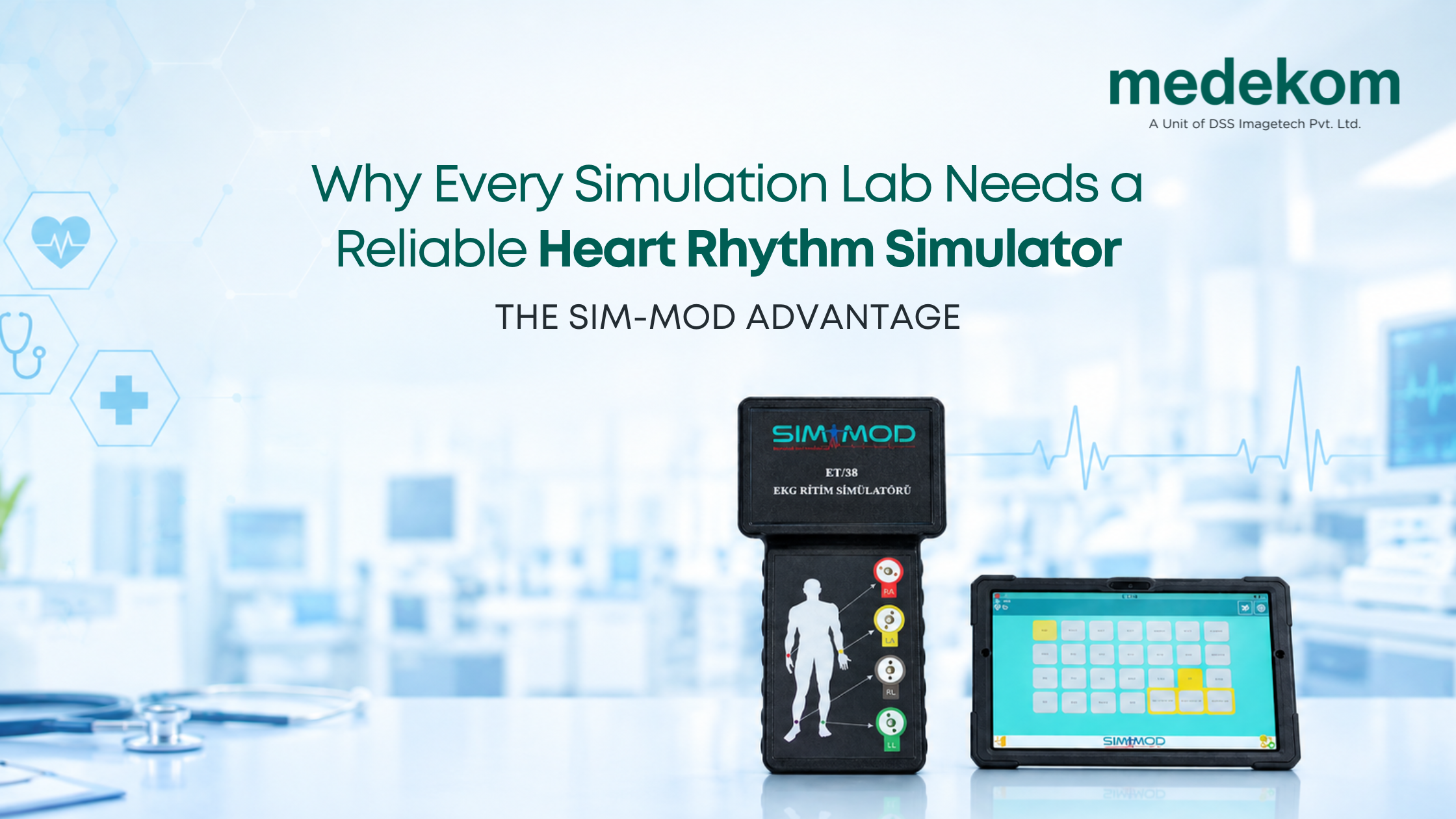
A lot of training tools try to teach ECG interpretation through static images or looping video. The trouble is, cardiac rhythms aren't static — they change with rate, with rhythm regularity, and with the patient in front of you. A true heart rhythm simulator needs to reproduce that variability convincingly, not just play back a recording. The SIM-MOD ET/38 does this by generating 43 distinct ECG rhythms covering both paediatric and adult presentations. This provides both adult (ACLS) and paediatric (PALS) rhythms in the same device. Instructors can move from a clean, boring normal sinus rhythm straight into something more urgent, like S-TACH, S-ARREST, or third-degree AV block, in the time it takes to tap a screen. Some of the rhythms available include:- NSR (Normal Sinus Rhythm)
- S-BRADY and S-TACH (sinus bradycardia and tachycardia)
- S-PAC and S-PVC (premature atrial/ventricular contractions)
- S-ARREST (sinus arrest)
- S-WPW (Wolff-Parkinson-White pattern)
- S-LONG QT
- 1°, 2° (Type I and II), and 3° AV block
- BBB (bundle branch block)
- Idioventricular rhythm and junctional rhythm
Real Hardware, Real Monitors
What separates a genuinely useful heart rhythm simulator from a gimmick is whether it plays nicely with the equipment learners will actually use on the job. This is where the ET/38 stands out — it connects directly to an actual bedside monitor or defibrillator, not a simulated screen built just for the classroom. That matters more than it sounds. A student who's only ever practiced on a simulator-specific display can freeze up the first time they see a rhythm on the hospital's own monitor. By running real rhythms through real hospital-grade equipment, SIM-MOD trains the eye and the instinct on the exact hardware clinicians will be reading in an actual code.Built for the Instructor, Not Just the Learner
Anyone who's run a simulation session knows the instructor's workload matters just as much as the learner's experience. Fumbling with cables or a clunky interface mid-scenario breaks immersion fast. The SIM-MOD ET/38 is controlled wirelessly through a 7-inch tablet, so instructors can adjust rhythms and heart rate from across the room without disrupting the scenario. Heart rate is adjustable directly from the control panel, letting facilitators escalate or de-escalate a case in real time — speeding a rhythm up as a "patient" deteriorates, or slowing it down as an intervention takes effect. It also runs for up to 8 hours on a rechargeable battery, which is enough for a full day of back-to-back sessions without hunting for an outlet between cohorts. At roughly 525 grams and about the size of a small paperback (20 x 10.5 x 4.5 cm), it's genuinely portable — easy to move between skills labs, wards, or off-site training venues.Quick Specs at a Glance: SIM-MOD ET/38
| Detail | Specification |
|---|---|
| Brand | SIM-MOD |
| Model | ET/38 |
| Rhythms generated | 43 (pediatric + adult) |
| Connectivity | Wireless, via 7" tablet control panel |
| Battery life | 8 hours, rechargeable |
| Dimensions | 20 x 10.5 x 4.5 cm |
| Weight | 525 g |
| Compatibility | Works with real bedside monitors/defibrillators |