By: medekomadmin
Simulation Training in Healthcare: How It Improves Patient Safety
October 16, 2026
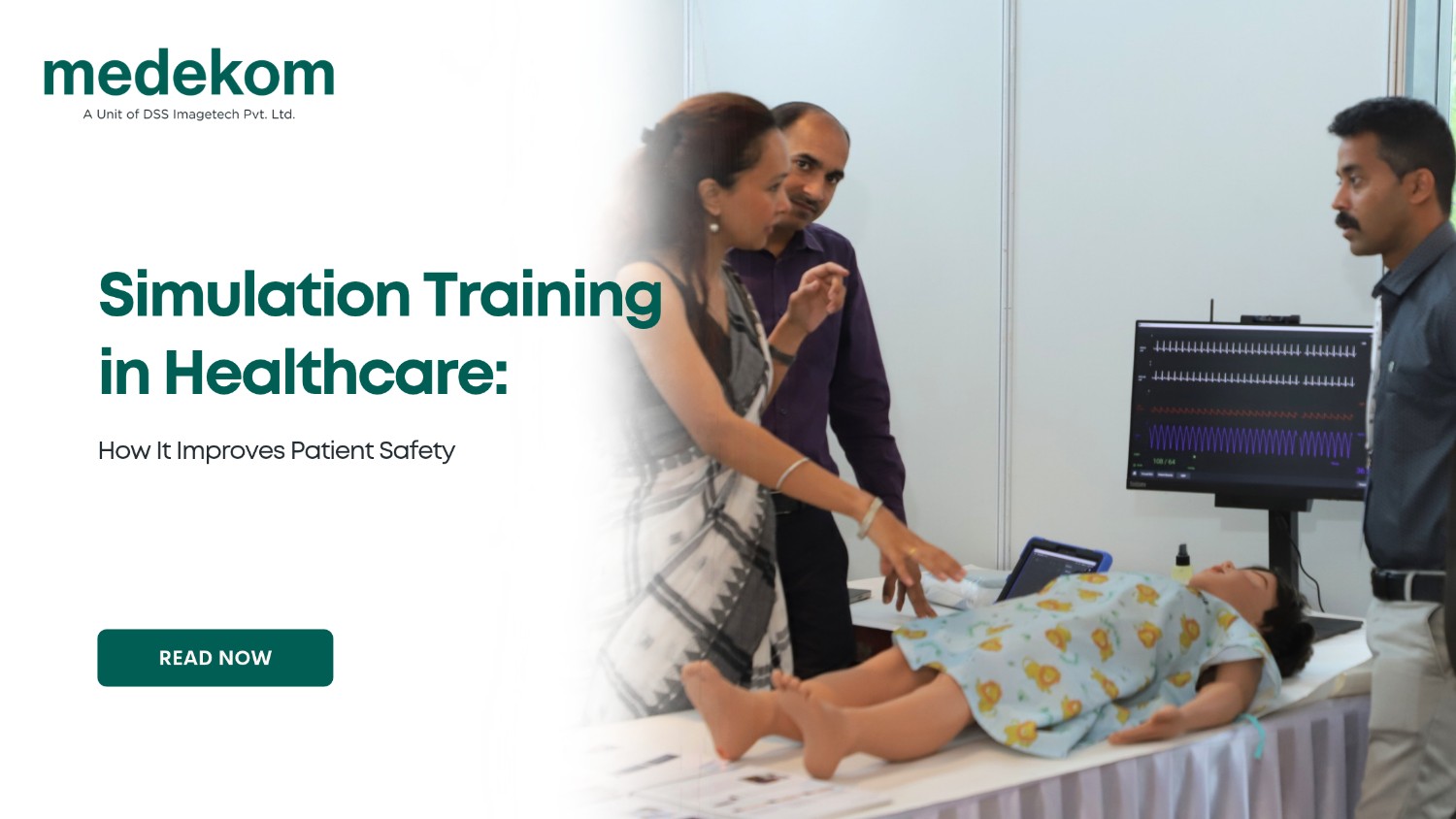
Nobody ever forgets their first real emergency. The trembling hands, the racing heart, that long silence before someone finally asks "Right, so what do we do now?" It's quite normal to be a bit on edge when you're learning something new, provided that level of nerves doesn't in any way increase the risk.
That's where simulation training comes in. Rather than doing any practical work on a real patient initially, the students and trainees will do all their practical work on mannequins and dummy patients to build up their practical knowledge. They can make all the mistakes they want during the procedure and learn from the multiple failed attempts. By the time they get to the real bedside the experience is behind them and the fear has become confidence.
In this blog we look at how healthcare simulation improves patient safety, what types of simulators are used and what a college or hospital should be thinking about before setting up a simulation programme.
For imaging-guided skills, a specialised task trainer such as the Mid Clavicular Thoracentesis Ultrasound Training Model lets learners practise needle placement safely. New to the basics? Start with our short read on the medical manikin.
Why Simulation Training Matters for Patient Safety
The vast majority of patient safety problems aren't due to one individual being careless. They're the result of small gaps. A student might have only done a skill twice. A team might never have run an emergency together. One key piece of information might have been missed during the handover. Simulation training enables students to identify those gaps at an early stage before they ever see a real patient. It allows the team and the individual to experience real life scenarios in a safe, risk free way which in turn builds their confidence and alertness in the face of the real thing. This is particularly pertinent in India. Many of the teaching hospitals have huge patient numbers so each student will only get a handful of opportunities to do any hands-on. The current model of competency based medical education and NABH accreditation is very much focused on the actual skills that you can demonstrate rather than just the theory. A skills lab is a way for the college and hospital to meet that need. Don't wait for the right case to come along. Make your own. Want to know how this works for nurses? Read our post on understanding simulation in nursing education. Every simulation goes through the same four steps and the debrief is by far the most important of those as it's in the debrief that the students actually get a sense of what went well, what didn't and what they need to do differently the next time.5 Ways Simulation Training Improves Patient Safety
1. Learners practice without putting anyone at risk
It can't feel pain and it never gets tired of doing it over and over again. Trainees can go through airway management, injections or chest compressions as many times as they like until the movements become second nature. The research supports this. A large JAMA review of over 600 studies found that technology enhanced simulation training was associated with significant gains in knowledge, skills and behaviour as compared to no training at all (Cook et al., 2011). Another review found that simulation with deliberate practice was often superior to traditional clinical education in the development of procedural skills (McGaghie et al., 2011). So the very first time a trainee does a procedure on a patient is not in fact the first time.2. Rare emergencies become familiar
A cardiac arrest, a difficult airway or a sudden drop in blood pressure doesn't happen every day, and many staff see only a handful early in their careers. Clinical simulation lets instructors recreate these moments on demand. A heart rhythm simulator like the SIM-MOD heart rhythm simulator helps learners recognize dangerous rhythms and respond quickly.3. Teams learn to communicate under pressure
Technical skill is only half the story. In a real emergency someone has to take the lead, someone has to call the drugs and someone has to say "hold on, that's the wrong dose". Team scenarios give the staff the opportunity to do all of that out loud. Imagine a simulated cardiac arrest. One learner is in charge, one is doing the compressions and one is on the drugs. The in-charge asks for adrenaline and the nurse reads it back. She spots the syringe is ten times too strong and says so. The dose is corrected and we carry on. In the debrief we talk about the importance of read backs. That one little habit that you pick up in the lab can prevent a real medication error on the ward.4. Debriefing turns mistakes into lessons
After each scenario the trainer and the learners all sit down and go through it. A good debrief has a very clear structure. It starts with the learners describing their experience of the scenario. Then we look at what actually happened and why, using open questions such as "What made you pick that drug first?" The debrief finishes with each learner identifying one thing they will do differently next time. It's a supportive environment, never a punitive one so people are free to make mistakes and to speak up. That's the habit that carries over to the ward. Simulation works because we talk about what we did, not just because we did it.5. Skills can be measured and kept fresh
Simulation allows hospitals to assess every learner against the same standard. The scenario can be assessed using a simple checklist (e.g. airway opened, compressions started in time, drug dose confirmed) and the instructor can simply sign off on the competencies once the learner has achieved them. As emergencies are so infrequent, skills decay rapidly so short refresher sessions every few months are key to keeping the experienced staff sharp. Running the same scenario over and over again also enables the team to see their own progress over time.Types of Simulators Used in Medical Simulation Training
Not every programme needs the most expensive equipment. Most institutions use a mix of two groups.| Low-fidelity trainers | High-fidelity patient simulators | |
|---|---|---|
| What they are | Simple models for practising a single skill | Realistic manikins that react like a patient |
| Behaviour | Static; no response to treatment | Show vital signs, respond to interventions, change during the scenario |
| Best for | First-year students, basic skills, large batches | Emergency scenarios, team training, advanced learners |
| Cost | Lower | Higher |
| Instructor training | Minimal | Moderate to high |
| Space and power | Small footprint | Dedicated room, power, often a control station |
| Example | BASICBilly+ Basic Life Support Simulator | Apollo patient simulator |
What to Check Before You Start
Buying equipment is the easy part. Before placing an order, ask:- Which skills do our learners most need to practise?
- Do we have the space, storage and power for the simulators?
- Who will train the instructors, and who will lead the debriefs?
- What service and spare-part support is available locally after purchase?
- Can we start small and add more simulators as the programme grows?
Frequently Asked Questions
What is the difference between low- and high-fidelity simulation?
Low-fidelity trainers are simple models for single skills. High-fidelity simulators react like a real patient, with changing vital signs and responses to treatment.Does simulation replace clinical training on real patients?
No. It prepares learners for it. Trainees build skills and confidence in the lab so they are safer and more effective at the bedside.Who can use simulation training?
Nursing and medical students, residents, paramedics and experienced staff doing refresher training.How do we start with a limited budget?
Begin with a few low-fidelity trainers for core skills, train your instructors in debriefing, and add high-fidelity simulators as the programme grows.Final Thoughts: Safer Patients Start in the Skills Lab
Simulation training gives learners a safer environment to practise, and making mistakes during their clinical learning process. Practice, teamwork, debriefing and measurement work together, and the benefit shows up where it matters most: in everyday care.About Medekom: Medical Equipment Distributor in India
Medekom is a trusted Medical Equipment Distributor in India, supplying healthcare simulation, patient monitoring, diagnostic tools and medical monitors to hospitals, colleges and clinics. With offices in 10+ cities, including New Delhi, Mumbai, Bangalore and Chennai, our team supports institutions from the first demo through training and after-sales service. We work with global brands such as Elevate Healthcare (formerly CAE Healthcare), Nasco Healthcare, 3B Scientific, SIM-MOD and Welch Allyn. Planning simulation training at your college or hospital? Explore our healthcare simulation range or contact our team for a quote and a live demo.References
- Cook DA, et al. "Technology-enhanced simulation for health professions education: a systematic review and meta-analysis." JAMA, 2011.
- McGaghie WC, et al. "Does simulation-based medical education with deliberate practice yield better results than traditional clinical education?" Academic Medicine, 2011.
Written by Aditya Paul & Yash Shah